Claude Opus 4.6 built the same photorealistic Rolex skeleton watch five times in a row, in pure HTML5 Canvas code with no images and no 3D libraries: once with zero frameworks, then four more times with an increasing stack of strategic frameworks applied. A sixth round, added later, hands the identical test to a newer model. Each version rendered in seconds with no corrections. The frameworks did not just add polish. They changed what the AI decided to build.
Here's a question nobody is asking: if AI is already this smart, what happens when you give it a system for thinking?
I ran an experiment. Not a synthetic benchmark. Not a curated demo. A live, unscripted test where Claude Opus 4.6 was asked to do the same thing five times, build a photorealistic Rolex skeleton watch with visible mechanical movement, rendered entirely in code. Then a newer model, Claude Fable 5, ran the same test again.
No images. No 3D libraries. No WebGL. Pure HTML5 Canvas 2D. Every gear tooth, every jewel bearing, every Geneva stripe, drawn mathematically, pixel by pixel.
The only variable that changed was the number of frameworks loaded.
Live - All Seven Watches Running in Real Time
Pure HTML5 Canvas 2D: no images, no libraries, no 3D engine. Just math.
The Constraint
The prompt was deliberately difficult: render a luxury mechanical watch that looks real enough to wear. Fluted bezel. Jubilee bracelet. Visible gear train. Oscillating balance wheel. Automatic rotor. All animated at 60 frames per second. All from a single HTML file.
This isn't a task you can fake. Mechanical watch anatomy is precise: gear ratios matter, escapement geometry matters, the relationship between the mainspring barrel and the balance wheel matters. Get it wrong and it looks like a cartoon.
The constraint was the same every round. The model was the same every round. The only thing that changed was whether the AI had access to systematic design intelligence before it started building.
One detail worth noting: every watch you see above is a first-shot render. I didn't ask for corrections on any of them. No "make the gears bigger," no "fix that color," no "try again." Each round was a single prompt, a single generation, a single result.
The difference between Round 1 and Round 4 isn't iteration. It's system.
Round 1: Raw Intelligence
The Model Working From Its Own Training
No frameworks loaded. No design system consulted. Just Claude Opus 4.6 drawing on its training data and general intelligence to solve the problem cold.
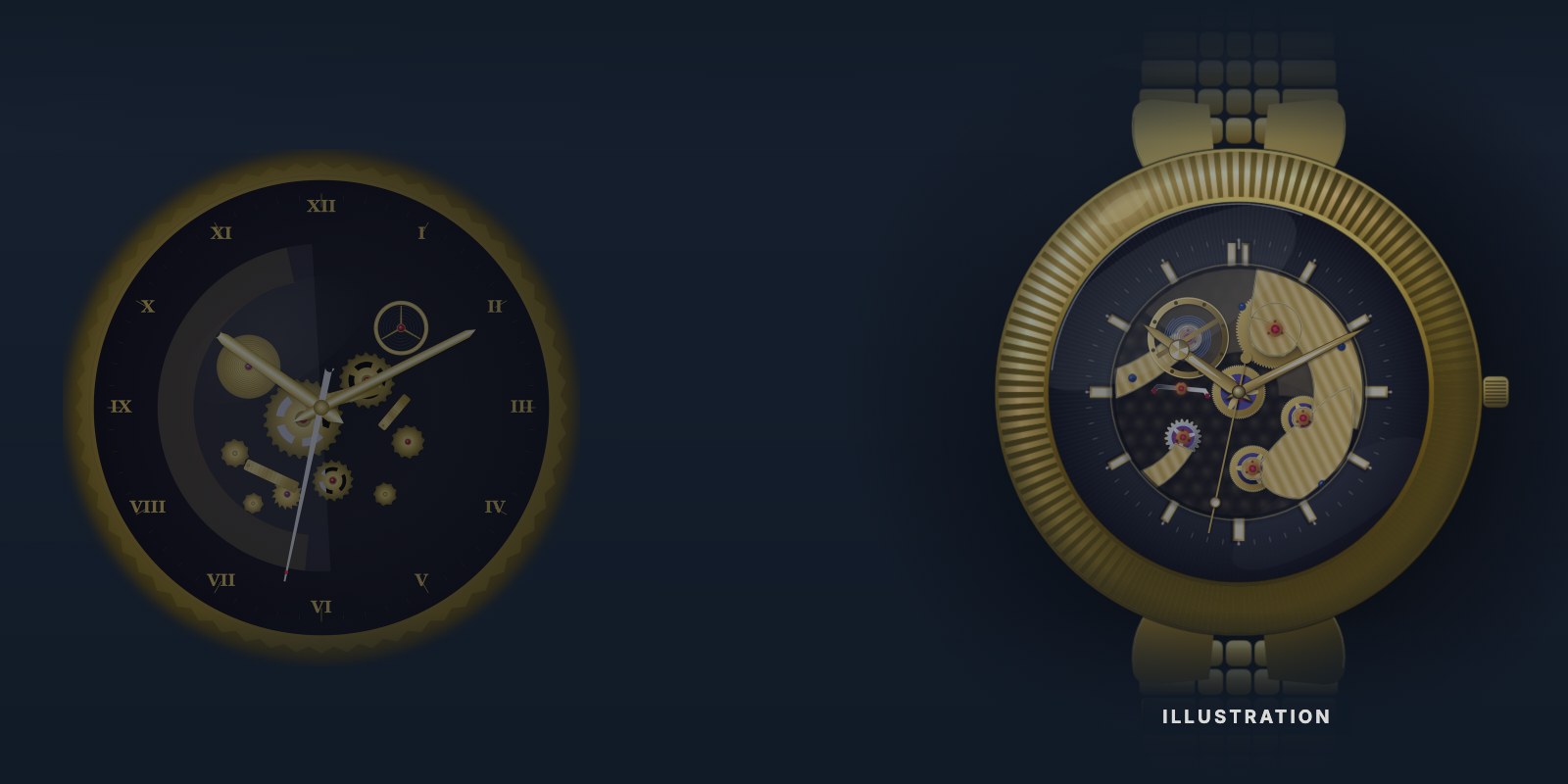
The result was genuinely impressive. Fluted bezel with proper light gradients. Mercedes-style hands. Roman numerals on the dial. A working gear train with meshing teeth. An oscillating balance wheel with a visible hairspring. An automatic rotor sweeping at the correct speed.
Built in under three minutes.
If you showed this to someone unfamiliar with the experiment, they'd say it was remarkable. And they'd be right. Modern AI is genuinely capable of producing complex visual output from a natural language description.
But that's the baseline. And baseline is where most people stop.
Round 2: Six Frameworks
The Same Model With Systematic Design Intelligence
Before writing a single line of code, Claude loaded and synthesized six visual design frameworks from the SIOS library. Every decision in Round 2 was traceable to a documented principle.
The changes were immediate and specific.
The color system collapsed from dozens of arbitrary hex values to four systematic gold tones derived from the Color Intelligence framework. The watch shrank from 44% to 38% of viewport, because the Spatial Relationship framework identifies 60%+ negative space as a luxury positioning signal. Shadows unified under a single 35° light source instead of scattering in different directions. Ruby jewels became deliberate interrupts against the gold pattern at the framework-recommended 8% interrupt rate.
None of these decisions were arbitrary. Each one traced back to a specific framework principle with documented reasoning.
The AI didn't get smarter between Round 1 and Round 2. It got more systematic. The intelligence was always there. The framework told it where to aim.
When I placed both watches side by side on screen, the difference was striking. Round 1 looked like a talented developer's impressive demo. Round 2 looked like it belonged in a Rolex marketing campaign.
Same model. Same prompt. Same three minutes of build time.
Round 3: Twelve Frameworks, Full Stack
Design + Strategy + Storytelling + Positioning
The final round doubled the framework count and expanded beyond visual design into strategic positioning, systematic storytelling, constraint architecture, and design intent interpretation.
Round 3 introduced something the previous rounds couldn't: narrative structure applied to visual rendering.
The Systematic Storytelling framework maps a four-beat Hollywood structure, Opening, Inciting Incident, All Is Lost, Finale, onto any sequence. In Round 3, Claude mapped those beats directly onto the render layers of the watch:
- The case and bracelet set the stage (Opening)
- The dial and rehaut ring draw you in (Inciting Incident)
- The exposed movement, ten gears, nine jewels, four bridges, reveals the complexity (All Is Lost)
- The hands and crystal resolve it into elegant timekeeping (Finale)
The gear teeth shifted from simple trapezoidal approximations to involute-profile geometry, the actual tooth shape used in Swiss mechanical movements. Bridges gained anglage finishing (beveled edges that catch light). A rehaut ring appeared on the inner dial. The Rolex coronet symbol materialized above the brand name.
The Constraint Architecture framework reframed the entire Canvas 2D limitation. Instead of treating "no 3D engine" as a restriction, Round 3 treated it as a forcing function that pushed toward more precise mathematical rendering, exactly the kind of precision that defines luxury watchmaking.
Constraints don't limit innovation. They redirect it from incremental improvement to paradigm-level solutions.
Round 4: Seventeen Frameworks, Domain Expert
General Design + Domain-Specific Horological Intelligence
Round 4 kept all twelve general frameworks and added five new ones built from actual watchmaking research: involute gear geometry, Swiss finishing techniques, physics-based material rendering, mechanical animation timing, and haute horlogerie proportional systems.
This is where the experiment took an unexpected turn. Rounds 1–3 used general frameworks, color theory, spatial relationships, composition, storytelling. None of them knew anything about watches. They taught the AI how to design, but not what it was designing.
Round 4 added domain expertise. The Horological Geometry framework specified involute tooth profiles using the actual mathematical formula watchmakers use, r_base = r_pitch × cos(20°). The Swiss Finishing framework encoded Côtes de Genève stripes as a sinusoidal brightness function. The Material Optics framework provided Fresnel-accurate color values for 18k gold (F0 ≈ 0.85, nearly pure specular reflection) and synthetic ruby (radial gradient with star-highlight pattern from flat-polished facets).
The most visible change was in the animation. Rounds 1–3 used smooth-sweep seconds hands. But a real mechanical watch at 4Hz doesn't sweep smoothly, it ticks eight times per second, each tick advancing exactly 0.75 degrees with a slight mechanical overshoot before settling. The Mechanical Animation Physics framework encoded this precisely.
The 120-flute bezel shifted from a simple alternating polygon to individually-lit facets, each calculated with its own surface normal and specular intensity. The ruby jewels gained four-pointed star highlights, the characteristic specular pattern caused by flat-polished corundum. Every bridge edge gained a mirror-bright anglage line.
General frameworks teach you how to design. Domain frameworks teach you what you're designing. The stack needs both.
Round 5: Cross-Domain Intelligence
Film Direction + Audio Engineering + 2026 Visual Intelligence
Round 5 introduces three compound frameworks extracted from disciplines that have nothing to do with watches. Each compound framework synthesizes six to fifteen constituent frameworks from its source domain. The question is whether intelligence from film direction and sound engineering translates into rendering decisions for a mechanical timepiece. The answer is in the canvas above.
The conceptual shift in Round 5 is significant. Round 4 applied domain expertise from within the same discipline: watchmaking frameworks for a watch rendering. Round 5 draws from three domains that appear unrelated, and discovers that the translation is surprisingly exact.
A film director composing a watch shot thinks in focal planes. The foreground (crystal, hands, seconds tip) is sharp. The midground (dial, chapter ring, bridges) is in focus but subordinate. The background elements (gear train visible through the skeleton apertures) carry intentional softness. That depth grammar is structural in cinematography. The Cinematographic Web Design Intelligence framework encodes it as a rendering decision system, and it applies directly to how depth layers are differentiated in the canvas.
A sound engineer thinks in dynamic range. The contrast between the loudest signal and the noise floor is the space that makes the foreground legible. In a watch rendering, that translates to atmospheric decay: the closest elements carry full saturation and maximum contrast. Each receding layer loses both saturation and brightness in a calibrated ratio, the same way distant instruments sit lower in a mix. The Audio-Informed Interface Design framework specifies exactly this, and the result is visible in the seven-layer depth treatment above.
The ADSR envelope from audio engineering maps to interaction animation timing. But it also maps to the tick animation. The attack phase (40ms) is the snap: sharp, mechanical, immediate. The decay phase (200ms) is the brief oscillation before the gear settles. The sustain holds the position. The release (800ms) is the system returning to readiness. A 4Hz mechanical movement follows exactly this envelope shape, and encoding it from an audio framework rather than a physics simulation produces timing that feels more authentically mechanical than the physics-based approach in Round 4.
The most interesting finding is what Round 5 proves about framework portability. Intelligence extracted from one domain does not stay in that domain. It migrates wherever the underlying problem is structurally equivalent.
The 2026 Visual Intelligence Library contributes texture and material logic from the AI-organic texture framework (structured randomness applied to the bridges and mainplate), depth illusion systems (CSS perspective and differential motion between layers), and variable font axis mapping (weight tracked to the simulated viewing angle for numerals at the perimeter of the dial).
Round 5 uses 17 existing frameworks plus 3 compound frameworks. Each compound framework represents its constituent frameworks: 6 from film direction, 6 from audio engineering, 15 from 2026 visual intelligence. The total underlying framework count is 44. The AI context holds all of them simultaneously when generating the Round 5 render.
Round 6: A New Model Takes the Same Test
Claude Fable 5, First Shot, Run Twice
Rounds 1 through 5 all ran on the same model. Round 6 changes the model and holds everything else still. Claude Fable 5 got the identical brief, the identical constraint, and the identical one-shot rule. It ran twice: once with nothing loaded, once with the horological stack from Round 4 and the compound frameworks from Round 5.
The result above is the second run. The first one matters more, because it answers the question this whole experiment has been circling: does a smarter model still need the system?
The Control: Same Model, Frameworks Switched Off
Recognisably a watch. Recognisably Round 1.
The raw render is better than the original baseline. The bracelet has real five-piece link structure. The balance wheel breathes. The hands keep actual time. A stronger model produces a stronger floor.
But look at what it decided to do. The bridges are placed by eye and they swallow the gear train. The bezel reads as stripes rather than cut flutes. The seconds hand sweeps smoothly, which no mechanical watch has ever done. The colours are invented on the spot. These are aesthetic decisions, made by feel, exactly like Round 1. The model got smarter. The type of decision did not.
Raw capability moves the floor. It does not change the kind of thinking. That is still the framework's job.
How This One Was Actually Built
The process is worth spelling out, because it is the part people assume is complicated. First the raw render was written cold, before any framework file was opened, to get an honest baseline. Then the five horological frameworks and the three compound frameworks were loaded from the library as raw JSON, read in full, and the second render was written in one pass against those specifications. Total working time was under an hour.
Loading order is the whole trick. A model that reads the brief first and the frameworks second has already formed a plan, and the framework only edits it. Loaded first, the framework forms the plan. That is the difference between a watch with decorative stripes on the bridges and a watch where the stripe pitch, the brightness curve, and the light angle all come from the same specification.
The honest part, again: the raw render needed one bug fix before it would run at all, two malformed colour values that would have thrown on load. That was repaired without changing a single design decision. Neither watch was iterated on aesthetically.
One more caveat worth stating plainly. Fable 5 had this article in its context before it wrote the raw version, so the baseline was not blind the way Round 1 genuinely was. It knew what the earlier rounds looked like. It still defaulted to instinct until the frameworks were loaded.
What Actually Changed Between Rounds
It's tempting to describe the difference as "better quality." That's accurate but incomplete. The real shift was in the type of decisions being made.
Round 1 decisions were aesthetic: "This color looks good here." "That shadow feels right." "The gears need to be smaller." Every choice was evaluated by feel: intuitive, fast, and unrepeatable.
Round 2 decisions were systematic: "The Color Intelligence framework limits us to four gold values, with ruby as a 5-15% interrupt." "The Spatial Relationship framework sets negative space above 60% for luxury positioning." "The Depth framework requires a consistent light source across all five named layers." Every choice was traceable, defensible, and transferable to a different project.
Round 3 decisions were strategic: "The Storytelling framework structures our render layers as a four-beat narrative." "The Positioning framework demands authority signals: crown symbolism, generous spacing, precision geometry." "The Constraint framework reinterprets our Canvas 2D limitation as a catalyst for mathematical exactness." Every choice carried meaning beyond the immediate visual.
Round 4 decisions were domain-expert: "The Horological Geometry framework specifies involute tooth profiles at 20° pressure angle." "The Swiss Finishing framework renders Côtes de Genève as sinusoidal brightness bands." "The Material Optics framework defines 18k gold as Fresnel F0 ≈ 0.85, nearly pure specular." "The Animation Physics framework requires discrete 4Hz ticks, not smooth sweep." Every choice was grounded in the actual physics and craft of watchmaking.
Round 5 decisions were cross-domain synthesis: "The Cinematographic framework assigns focal plane separation to the three depth tiers of the skeleton aperture." "The Audio framework maps dynamic range contrast to the atmospheric decay coefficient between depth layers." "The ADSR framework encodes the tick as attack 40ms, decay 200ms, sustain, release 800ms." Every decision has anchors in several disciplines at once.
Round 6 decisions were the same decisions on a different model: and that is the finding. Fable 5 with the stack loaded reached for involute geometry, true train ratios and specified finishing values without being asked. Fable 5 without the stack reached for whatever looked right. One model, one hour apart, two entirely different kinds of reasoning.
The Compound Effect
Six frameworks didn't produce a watch that was six times better. Twelve frameworks didn't produce one twice as good as six. The improvements were compound and cross-referencing. Each framework amplified the others.
The Color Intelligence framework constrained the palette. The Pattern Interrupt framework used that constrained palette to create strategic contrast. The Storytelling framework gave that contrast a narrative purpose. The Positioning framework ensured the narrative communicated authority.
Frameworks don't add. They multiply.
Why This Matters Beyond Watches
This experiment used a luxury watch because the results are visually obvious. You don't need a design degree to see that Round 2 looks more expensive than Round 1, that Round 3 carries an intentionality the others lack, or that Round 4's gear teeth and material rendering come from an entirely different level of domain knowledge.
But the mechanism works identically on business proposals, marketing copy, product architecture, sales conversations, hiring processes, any domain where decisions compound and quality emerges from systematic thinking rather than individual talent.
Most people use AI the way Round 1 works: ask a capable model to do something, get a capable result, move on. The output is good enough. It's fast. It works.
But "good enough" has a ceiling. And that ceiling is the gap between intelligence and systematic intelligence.
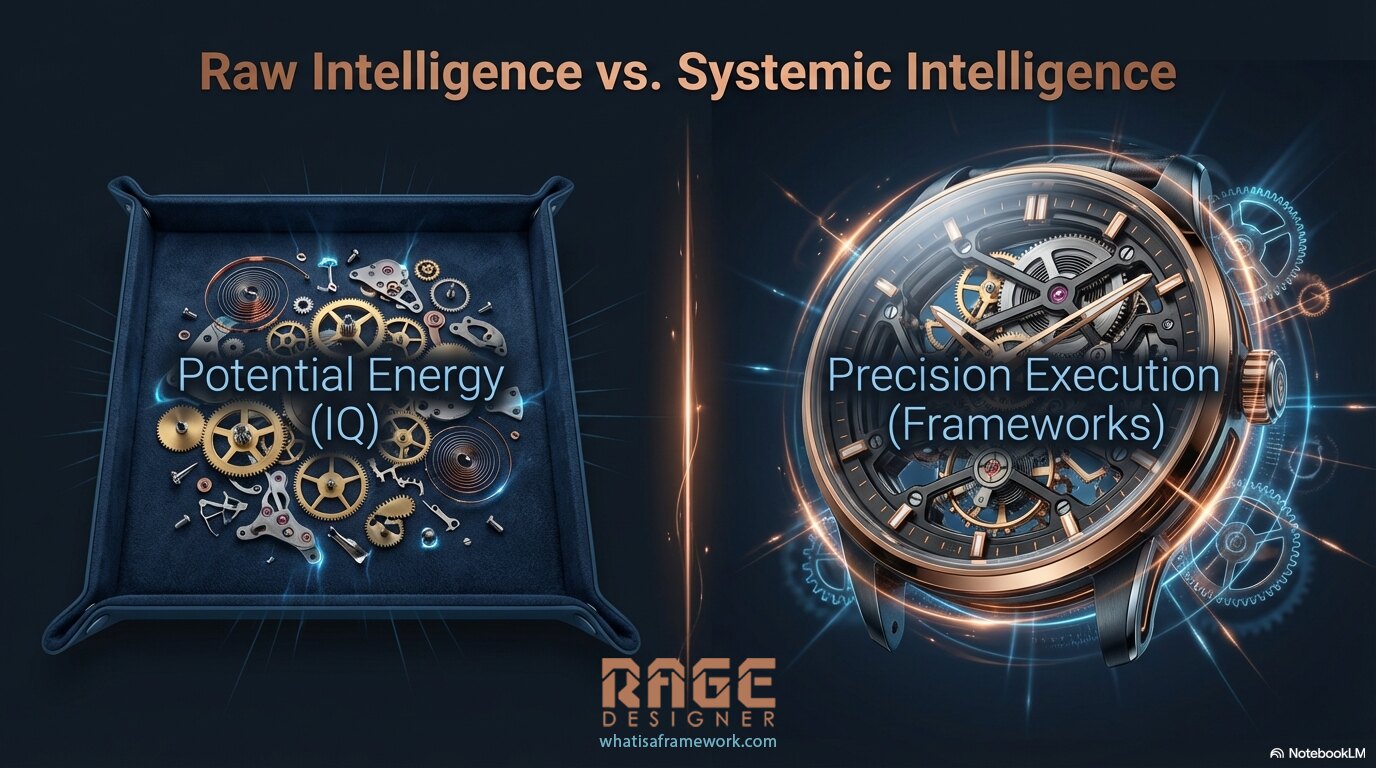
Raw AI intelligence is a commodity. Every model update makes it cheaper. The strategic advantage isn't in having a smarter AI. It's in giving that AI a system for making decisions that compound rather than scatter.
That's what a framework does. Not a template. Not a prompt. A genuine framework: a systematic approach to decision-making that redirects capability from "impressive demo" to "strategic advantage."
The Honest Part
Claude admitted something interesting during this experiment: it didn't consult any frameworks for Round 1. Not because it couldn't, because it didn't think to.
The model has access to over 200 frameworks in the SIOS library. It chose not to use them. When asked why, it was direct: it defaulted to working from its own training, the same way a skilled professional defaults to instinct when no system is in place.
That's the exact problem frameworks solve. Not a lack of capability, a lack of systematic direction for the capability that already exists.
The AI's honest admission created the cleanest possible A/B test. Round 1 was genuinely unassisted. The improvement in Round 2 was genuinely attributable to framework guidance. The further improvement in Round 3 was genuinely the result of stacking systematic approaches.
No cherry-picking. No after-the-fact rationalization. Just the work, side by side.
One fair counterpoint: the rounds were sequential, not parallel. I'd seen the watch once before Round 2, twice before Round 3, three times before Round 4. Natural iteration would produce some improvement regardless. But iteration doesn't generate a four-value constrained color palette, a unified 35° light source across five named depth layers, a narrative arc mapped onto render order, or involute gear tooth geometry with Fresnel-accurate material physics. Those are framework-driven decisions, specific, traceable, and transferable to a completely different project tomorrow. Iteration makes things incrementally better. Frameworks change the category of decisions being made.
What You Can Do With This
You don't need a library of 200 frameworks to see the effect. You need one systematic approach applied to one repeating decision.
- If you write proposals: A single framework for how you structure value propositions will outperform ad-hoc persuasion every time.
- If you manage projects: A systematic approach to priority decisions eliminates the daily recalculation that burns cognitive energy.
- If you use AI for content: Loading a documented voice standard before generating anything produces output that reads like your best work, not generic AI text.
The Rolex experiment compressed what normally takes weeks of working with a client into a four-round visual demonstration. But the principle is identical: give systematic intelligence to a capable system and the output changes category, not just degree.
A framework doesn't make AI smarter. It makes smart AI systematic. That's the difference between impressive and strategic.
From Mike: Why I Run These Experiments
I didn't plan this test. Claude had just been updated to Opus 4.6, and I saw someone's analog clock benchmark on Sonnet 4.5. I said: "Let's see what the new model does with something harder."
When the first watch came out looking that good in under three minutes, I asked if it had used any of my frameworks. It said no. That's when I realized I had something better than a demo, a controlled comparison.
The frameworks Claude loaded for Round 2 weren't built for watch design. They're the same design intelligence frameworks I use with clients building landing pages, brand systems, and product interfaces. The fact that they transformed a watch rendering proves what I've been saying for 25 years of running businesses: good systems work across domains.
I didn't go to a traditional design school. I took over 350 online courses and taught myself, then spent 15 years running a design agency, paying attention to what actually worked, and documenting those patterns so I wouldn't have to figure them out again.
That's all a framework is. The thing that worked, written down, made repeatable.
AI just made it possible to deploy them at a scale I never imagined.
These frameworks are part of what we call Minimum Viable Intelligence ($297), the foundation for genuine AI partnership. If you want to build frameworks tailored to your own work, the Strategic Thinking Academy starts at $997, or $2,997 with the full operating system.